Psychological drama
Philosophical fairy tale
Saga
Dystopia
Parallel world
Home/boarding school
Pupils
Superhumans
Love
Friendship
Escape
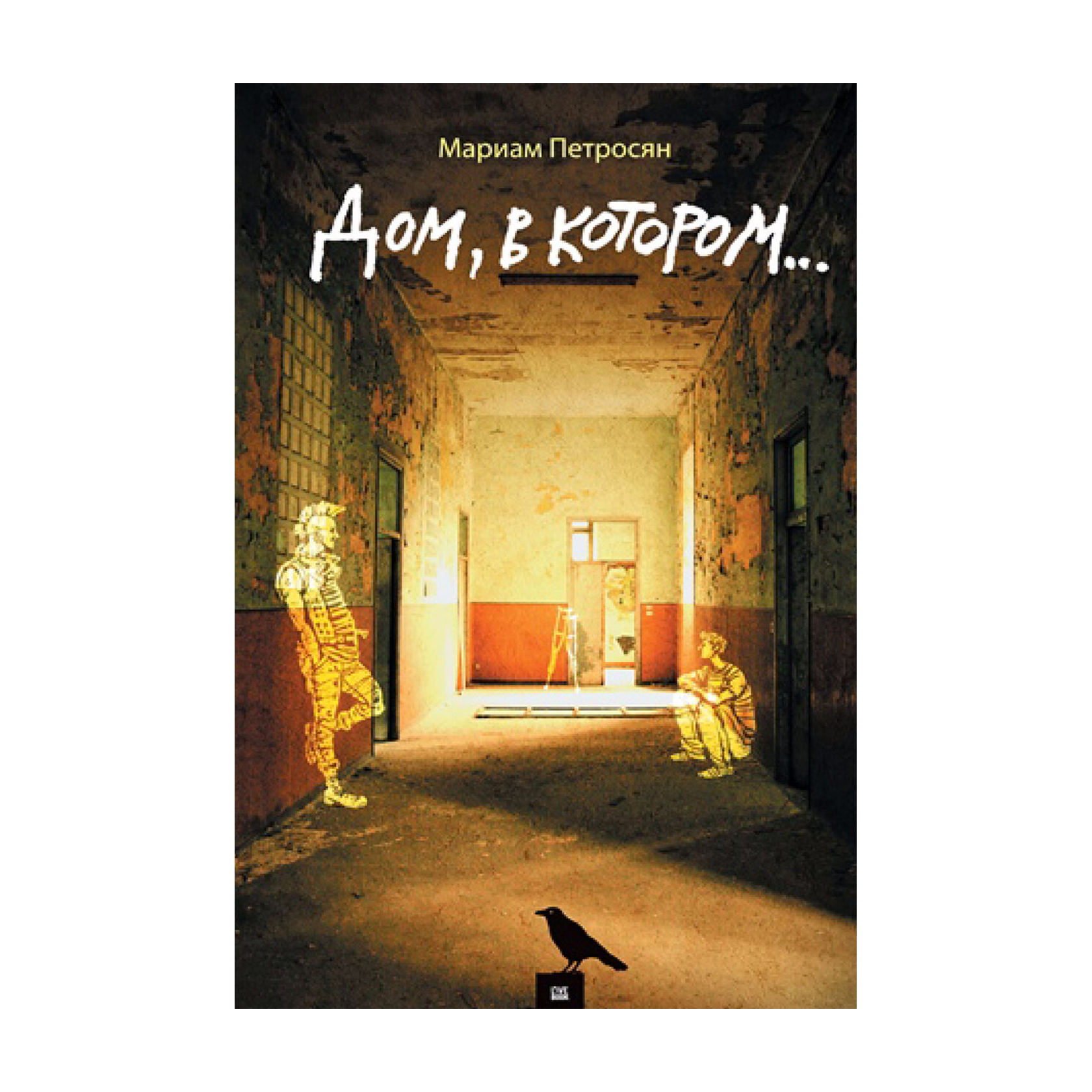
Mariam Petrosyan is an Armenian artist, animator and writer. "The House in Which ..." is the author's first book. About 20 years passed from the time she began working on it until its publication in 2009. She was talked about as an exceptional work immediately after the book was published, the novel brought the author several literary awards.
REFERENCES
"Miss Peregrine's Home for Peculiar Children" (dir. T. Burton, 2016)
"X-Men" (sci-fi film series, Marvel comics)
"Sailor Moon" (anime, 1992-1997)
PLOT
A young man nicknamed the Smoking Man quarrels with his group—exemplary hypocrites and snitches—and he is transferred to another. From this moment begins his real acquaintance with the Home—a boarding school for disabled children with more than a century of history, a place full of secrets and mysticism. Along with the Smoker, the reader gets to know the inhabitants of the House, its rules, and its established traditions. He learns that all the inhabitants, even the teachers and directors, are called only by nicknames, that less than a year remains until graduation, and that the fear of the "Outside"—what lies beyond the House—is such that not a single graduation passes peacefully. The previous graduation, seven years ago, was the most terrifying in the history of the House—graduates, divided into two groups, drowned the House in blood. When the author allows the opportunity to see the House through the eyes of other students, it turns out that there is a parallel world, the "inside of the house." That some inhabitants are Walkers, who can go there, disappearing into the real world, and return. And others—the Jumpers—are thrown there, and they can return after days and weeks in a coma in the real world, but having lived many years there. That the director has no power over the teacher, the teacher has no power over the Blind, and the Blind believes that he is not the leader of the boarding school, but only carries out the will of the House.
As the denouement approaches, more and more unknowns are revealed, and more and more questions arise. And the main question for the inhabitants is whether to leave or stay, because after this episode the House will be demolished. And some choose to leave: to go outside and forever remain in the world where they were born. And others—to stay: to stay with the House and go to another world, belonging only to them. Maybe not forever.
ABOUT THE BOOK
Olga Lebedushkina:
"Many of Mariam Petrosyan's characters were first drawn by the author and only then became part of the text. The very principle of creating an image in the novel is rather visual, coming from one or several striking details, a prominent spot of color: the Witch - a hat and mouth, the Smoker - red sneakers, the first appearance of Tabaqui - three colored vests and three T-shirts hanging from one another, plus an orange turban. The eyes and eye color play a special role. All of these are typical animation techniques, which is not at all surprising in the case of Mariam Petrosyan, who worked for several years first at Soyuzmultfilm, then at the Armenfilm studio. Petrosyan the artist's graphics also partly bears the influence of anime, and in her interviews Mariam often admits that the aesthetics of anime in the novel is present. True, this presence is not limited to the practical visuality of her writing.
The plot itself - teenage heroes with unique abilities - is one of the most typical for anime culture: it is enough to recall such classics of the genre as Sailor Moon, Naruto, White Cross, Hellsing, etc. The narrative structure in The House Where ... is reminiscent of an anime saga with its sequels, prequels and flashbacks. Interestingly, this is also a kind of response to another literary expectation - the general longing for a large epic form. In circumstances where the great Russian novel has almost become equal to the international canon of the novel - 120 pages on average - Mariam Petrosyan managed to write a "big book" that is read avidly. Moreover, the role of generations in this new saga is played by the releases of the pets of the House.
And you can also remember the "X-Men" with all the products of Marvel Studios - from comics and animated series and ending with a cinematic tetralogy. The theme of the “X-Men” is indeed somewhere very close to “The House in Which…”, especially in the part where frightened and lonely young mutant superhumans are gathered in a boarding school for the especially gifted by Professor Xavier. It is no coincidence that the popularity of this plot in modern popular culture, and especially among young audiences, is associated primarily with the motif of childhood loneliness, understood as superhumanity.
These codes of the latest mass culture mythology are perfectly read by young readers. That is why Mariam Petrosyan immediately gained a significant number of online fans. Fan fiction is already being written about “The House in Which…”. What else is needed in our time for fame…"
Dmitry Bykov:
"Some provisions of the new ethics formulated by Petrosyan’s heroes are quite traditional: for example, curses come back to you and they hit you with a ricochet; the basis of the world order is mutual understanding among black sheep; the shortest path to power is to become an outcast among outcasts (the brotherhood of the Plague Wheezers is the best thing in this book, and the most pleasant to read about). I liked the storyline of the Wolf and the Grasshopper the most, someone will be closer to the Red One, and the Red One’s storyline is generally interesting, because love in the world of superhumans is unusual, it is based not on mutual understanding and not on physical attraction. Another important compositional law of the superhuman world is its fundamental nonlinearity: we think that a blind man is endowed with a sense of smell (“But I smell and hear well”), but he, perhaps, is endowed with fast legs, and what is he to do with them? In the new world – the nonlinear and multidimensional space of home – retribution does not come according to sins, and compensation is not given for what was taken away. And you have to get used to this, as well as to "that the main value, even in this frozen space, where retarded children speak and think at the level of the smartest adults, still remains humanity. More precisely, superhumanity, that is, a very high degree of delicacy and compassion."
SYNOPSIS
Book 1. The Smoker
The home for the disabled, located on the outskirts of the city, is disliked by the locals, they call it the Gray House and consider it strange. The children in the House are divided into groups, each of which has a leader. Everyone who gets into the House changes their name to a nickname.One of the newcomers, a wheelchair-bound Smoker, unfamiliar with the rules and history of the House, ends up in the fourth group, the guys from which are feared and respected.
Smoker is a wheelchair-bound person, a new inhabitant of the Gray House.
The leader of the group, a teenager blind from birth, is called Blind.
Blind is the leader of the fourth group, considered the head of the Gray House.
Smoker has a hard time getting used to the group, where everyone except the calm and reasonable Black seems strange to him.
Black is calm, A sensible and almost healthy teenager from the fourth group, a friend of the Smoker, was called Athlete in childhood.
Gradually, the Smoker learns about the past of the house and the strange death of one of the pack. Black tells him about the recently dismissed teacher Ralph.
Ralph is the teacher of the Gray House.
The Smoker sees strange dreams, but still considers the unusual rules of the Gray House a game.
There is no happier person than a real fool.
Soon, the leader of the Dogs group begins to lay claim to the place of the Blind Man, who is considered the head of the House. Between the leaders, according to the rules of the House, a mortal fight occurs, Blind Man wins. To the Smoker's horror and outrage, the residents of Graydom accept this murder as a normal occurrence.
The narrative is interspersed with interludes that tell the story of the orphan Blind and the Sphinx, who was born without arms and was cared for by one of the caregivers.
Sphinx is the second in the House after Blind, born without arms, and was called Grasshopper as a child.
The House is effectively run by senior students. One of them, a sage and sorcerer, becomes the Sphinx's teacher.
The Sphinx is placed in a boarding hospital for prosthetics—the Graveyard, the most terrible place in the House, thoroughly saturated with disease and suffering. There he learns of the "Upside Down"—a parallel reality created by the House. Those who can enter it voluntarily and return are called Walkers, while those who end up there by accident are called Jumpers. Time flows differently on the Inside Out than in reality.
One of the fourth group, wheelchair-bound Lord, is a jumper.
Lord is a wheelchair-bound invalid from the fourth group, a very handsome teenager.
Under the influence of drugs, he "jumps" to the Inside Out of the House, falls into a stupor and ends up in the Boneyard. Blind —a Walker, he perceives the Inside Out as a forest and turns into a werewolf there.
Returning from prosthetics, Sphinx and Blind gather all the offended and rejected into a flock. They are joined by Tabaki, the most troublesome wheelchair user in the House, and then by Black.
Tabaki— a wheelchair user from the fourth group, who later turned out to be the Keeper of Time.
Book 2. The Jackal's Eight-Diary
After fifteen years of absence, educator Ralph returns to the House. He knows that his charges are afraid of the "outside"—life outside the boarding school, and wants to rid them of this fear. At the request of the Blind Man, Ralph releases Lord from the mental hospital.A new law is introduced in the House—now boys are allowed to communicate with girls. By winter, friendships have developed between the boys and girls of the House. The Sphinx gains a girlfriend.
During the Longest Night, miracles happen. Ralph discovers that time has stood still in the House and that this night really is the longest.
The internal clock has long since struck dawn. But the night does not end. Because this is the Longest Night, the one that comes only once a year.
The Interludes tell how the Sphinx gains power. The blind man guards his beloved teacher at night and reads the dreams of those sleeping. The leader of the House leaves, and the Blind One is eyeing his place.
Book 3. Empty Nests
Six months pass, graduation approaches, and the House is growing uneasy. Many still remember the horrors of the previous graduation, when most of the seniors committed suicide. Then, seeing pools of blood, the Sphinx first found himself on the inside of the House, where seven years passed for him. In the real world, he lay in a coma for several months, and, when he woke up, he changed his nickname. His favorite teacher also died then.The Sphinx doesn't like the inside. He is convinced that the House itself chooses who will be the Jumper.
The House is not responsible for those it does not let into itself. He is not even responsible for those he lets in.
During the Longest Night, a fight breaks out between the Black and the Blind for the position of leader of the House. The Blind wins again, using his gift, and the Black becomes the leader of the Dogs.
Many teachers want to postpone the graduation day so that the graduates do not have time to misbehave, and remove the most dangerous ones from the House in advance. Considering this cruelty, Ralph goes down to the basement to rummage through the archives and discovers that the House's caretaker is the former director, fired for unrest before that bloody graduation. The caretaker tells the teacher many interesting things, although Ralph himself has already begun to guess that the House is a special place. The man who built it set up a foundation to maintain the House in good condition. He bequeathed his entire fortune to it on the condition that only disabled children would live there. For almost a hundred years, the house has become imbued with the energy of children's souls and has begun to create its own reality. Ralph understands that the House changes the children living there. He treats his charges not as unfortunate disabled children, but as unfamiliar and dangerous creatures. The teacher recruits the Cigarette Smoking Man, who begins keeping a diary, recording everything that happens in the House so he can give it to Ralph to read later. The Blind Man breaks out in a rash. It's the Lost Disease—that's how the House marks those who have no place in the Outside. The Lord realizes that Tobaki is a powerful Master of Time, an eternal child, an eternal old man. He transports the Lord to a reality where he was born healthy. The Blind Man asks one of the Jumpers to take all the mentally retarded people who don't belong in the Outside to the Inside Out on the night before graduation. He invites the Sphinx to go with him forever to a parallel world, where he will become completely healthy, but he refuses—he wants to live his life among people with the girl he loves. The friends are about to part forever.
The Night of Fairy Tales begins, the last one before graduation. The fourth group receives guests, and Black tells about the bus he stole, on which everyone can secretly leave the House without going through graduation.
Black takes many of the guys away on the bus; the mentally retarded ones mentally go to the inside out, and their bodies fall into a state similar to lethargy. After a hasty release, the House is demolished.
Epilogue
The epilogue tells the story of the main characters' subsequent fates. Blind and Tabaki disappear without a trace—their House has changed them more than anyone else; they are capable of slipping into the underworld not only mentally but also physically.Mentally retarded people in a lethargic state are called "sleepers," and much is written about them in the press, but no one understands the essence of this phenomenon. Gradually, they begin to disappear—to slip into the underworld physically. There, the "sleepers" turn into children, and Jumper, who looks after them, returns them to reality and places them with childless families.
The Smoker, who never succumbed to the influence of the House, becomes an artist, whose strange paintings are echoes of dreams inspired by the House. Only the Sphinx, who has become a child psychologist, understands the true meaning of his paintings.
After graduation, the Sphinx realized that his beloved does not exist—the House created her to keep him within itself. Realizing this, the Sphinx goes to the ruins of the House to say goodbye, because he once left it without looking back. Taking pity on him, the House returns the girl to him and the Blind Man, who has turned into a child inside out.