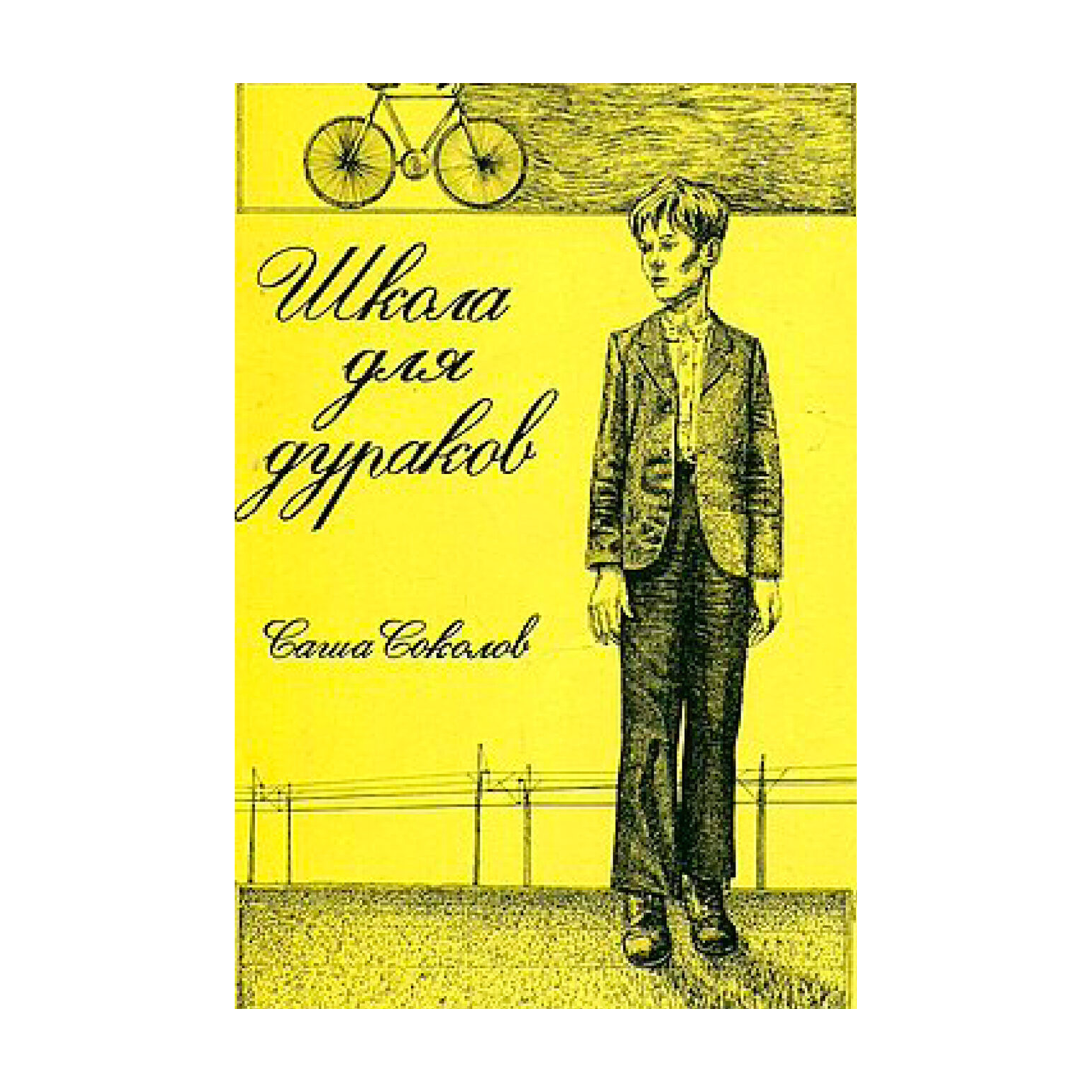
The book is an internal monologue of a student at a special school for children, as they would say today, "with special needs"—or rather, his dialogue with his alter ego. It can be assumed that the hero's (heroes') experiences are connected with the dacha village where his family lives and the picturesque surrounding countryside, with his geography teacher Pavel Norvegov (probably already deceased), and with the professor's daughter Veta Akatova, to whom the narrator is partial—but these are only hypotheses. In the text, nothing is final or reliable: reality loses its familiar contours and is seen as if for the first time.
ABOUT THE BOOK
"School for Fools" is dedicated to "the feeble-minded boy Vita Plyaskin, my friend and neighbor": although the text does not say this directly, the title and dedication make it clear that the book's hero (who is also the narrator) studies in a boarding school for mentally retarded children. In one of his interviews, the writersays that the feeble-minded boy Vitya Plyaskin really existed, lived in an apartment building on Velozavodskaya, and was Sokolov's first childhood friend.
The main symptom (and repeatedly played out in the text), a sign of his "abnormality" is a split personality: the narrator conducts a continuous dialogue with his second "I", while we are not given the opportunity to understand which of the hypothetical personalities is conducting the conversation at any given moment and how they differ. In the narrator's perception, not only the boundaries of his own self are blurred, but the contours of reality in general: time moves in all directions, the dead exist on equal terms with the living, a railway line turns into an acacia branch, and that branch turns into a girl named Veta. This total blurring is accompanied by a particular intensity of perception: the narrator seems to rediscover the reality around him—and therefore abandons the usual methods of describing it. As writer Dmitry Danilov notes, "the author (or the hero, the heroes, or the text itself—it's not entirely clear who exactly; probably all of them) looks at the seemingly simple world around him with a constant, unrelenting, intense wonder. "The world responds, becoming ever more astonishing under this gaze."
The name Vitya Plyaskin is seen as an allusion to St. Vitus's Dance—a disorder also known as chorea or choreic hyperkinesis, characterized by disordered, chaotic, and uncontrolled movements. Similar characteristics could, if desired, be attributed to the speech of the narrator of "School," but not to his physical behavior. If one were to seriously diagnose the narrator, one would be more likely to speak of dissociative identity disorder—a condition in which two or more equal personalities coexist in a person's consciousness. However, the novel's hero's condition only partially corresponds to this diagnosis: in a classic identity disorder, different personalities gain control of consciousness sequentially, they are distinguished by different properties and characteristics, and also know nothing about each other—while the narrator's personalities are in constant dialogue and are practically indistinguishable. To top it all off, these individuals at times experience themselves as existing to a "greater or lesser degree"—experiencing a partial transformation into a water lily or a distant waltz; their bodily concreteness, their belonging to a single physical body, is also called into question. All these astonishing manifestations of consciousness are almost impossible to fit into a precise medical classification (fortunately, the fictional narrator, with his subtle disorders, has no need to consult a doctor).
Of course, the text of "School" is not a medical certificate or even an attempt to convey the worldview of a "special" child: first and foremost, the author requires such a narrator to justify the rejection of genre and narrative conventions. The student at the "school for fools," as we see him in the text, least of all resembles a sick person or a madman. He is, above all, a person with a heightened, fresh, and strange perception of the world, capable of expressing it in a surprising and unique way: a poet, an artist, a prophet.
The text is practically devoid of details that would allow us to tie it to a specific time. Details of school and dacha life suggest that these are the Soviet, or more precisely, post-war years. The first pages describe the village residents hurrying from the station to their homes, where, among other things, they watch television. Regarding Academician Akatov, we learn that "people in snow-covered coats" took him away for a long time and beat him in the stomach, and then released him and gave him an incentive bonus—this is definitely a reference to the relatively recent liberation from the camp. The relatively widespread use of television and the still-fresh memory of post-Stalin rehabilitation suggest that the action takes place in the early or mid-1960s. The exact location is completely impossible to determine; the only specific geographical detail—the Leta River flowing near the village—immediately sends us from the Moscow region village to the border between the visible and the otherworldly worlds (on which, in a sense, the narrator constantly finds himself). Sokolov himself said in an interview that he was trying to depict dacha life in general: “For me, the Moscow region has always been more than Moscow, so you could say that in my first novel I confessed my love for the nature of the Moscow region. As a child, I lived in different dachas at different times, so there is no specific place. Well, the Kiev direction, the Belarusian one... Dacha life is a typical phenomenon, my childhood and youth were no different from any other in any way."
The state of total relativity and uncertainty in which the narrator finds himself also affects the flow of time: it is perceived as one of the habits of everyday consciousness, it can be questioned. "Our calendars are too arbitrary, and the numbers written on them mean nothing and are not backed by anything, like counterfeit money. Why, for example, is it customary to think that the first of January is followed by the second, and not immediately by the twenty-eighth. And can days even follow one another? This is some kind of poetic nonsense - a succession of days. There is no succession of days, days come whenever they please, and sometimes even several at once."
This world becomes fluid and uncertain. In it, the laws of classical logic cease to apply—objects are not equal to themselves, and two opposing statements can both be true. A person turns into a flower, and that flower into a railroad line, sometimes at the distance of a single sentence. In the world of "School," the boundaries between the animate and the inanimate are erased: "A bicycle, a barrel, or a weather vane, not to mention the wind, the river, and the lily, are endowed with character and are capable of influencing the plot." This irrational or super-intellectual perception reveals a depth that the ordinary eye cannot see: the narrator may not notice the obvious, but sense the surprising. On the last page of the novel, the narrator's flow of speech is interrupted by the author's remark: "Student so-and-so, allow me, the author, to interrupt your narrative again. "The thing is, it's time to finish the book: I'm out of paper." The narrator says he could also tell the story of his own wedding with Veta Akatova, as well as how the river near the village overflowed its banks and flooded all the dachas—after which the narrator and the author go outside and "miraculously transform into passersby." This incompleteness, this fragmented quality, isn't just a nod to tradition; it corresponds to the uncertainty of the world of "School": a story about it can't be finished, it can only be cut short. We (the author, the narrator, the reader) see the prospect of a happy and simultaneously apocalyptic ending, but we refuse to reach that point—the creator of this text exits it, as one exits a house onto the street (not forgetting to mention this route in the text).